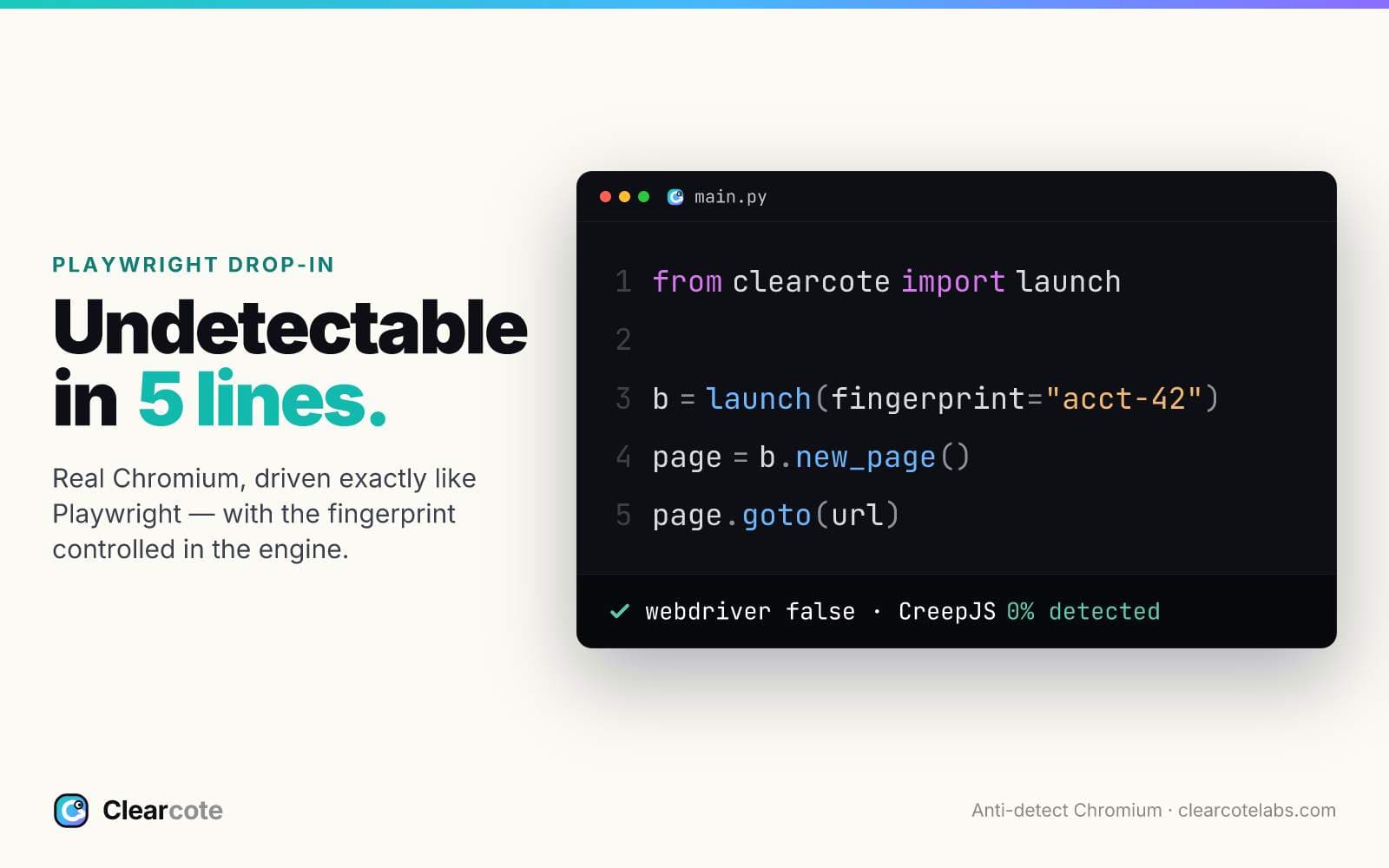
Clearcote is an open-source browser project built on Chromium that focuses on privacy, fingerprint consistency, and browser automation. Instead of relying on JavaScript injection or browser patches that modify web pages after they load, Clearcote implements identity controls directly within the browser engine itself. This approach is designed to produce a coherent browser identity that appears natural and internally consistent across different fingerprinting surfaces while remaining compatible with existing automation frameworks. The project positions itself as a transparent, developer-friendly alternative to many commercial anti-detection browsers by making its source code, patches, and build process publicly available. The platform is built on a de-Googled version of Chromium, removing Google services, telemetry, and unnecessary integrations while preserving compatibility with the Chromium ecosystem. Developers can continue using familiar automation libraries such as Playwright and Puppeteer with minimal code changes, simply replacing the browser binary or SDK import. The website demonstrates how a browser instance can be launched through a straightforward Python API, allowing developers to assign deterministic fingerprint identities using a single seed while maintaining compatibility with existing browser automation workflows. One of Clearcote's defining characteristics is its engine-level fingerprint management. Rather than modifying browser properties through injected JavaScript or browser debugging protocols, identity characteristics are compiled directly into the browser itself. This allows websites to observe native browser behavior instead of detecting artifacts introduced by runtime modifications. The project emphasizes that all identity-related signals are managed together to create a realistic and internally consistent browsing profile instead of producing isolated values that may contradict one another. The website lists an extensive collection of browser signals that can be controlled, including Canvas rendering, WebGL, WebGPU, AudioContext, fonts, screen geometry, timezone, hardware concurrency, device memory, storage quotas, language settings, User-Agent information, UA Client Hints, WebRTC behavior, battery information, keyboard layouts, media capabilities, network characteristics, TLS fingerprints, and many additional browser APIs. By coordinating these values from a single deterministic identity, Clearcote aims to reduce inconsistencies that can contribute to browser fingerprint uniqueness. Transparency is a recurring theme throughout the platform. Every public release is accompanied by reproducible builds, signed binaries, checksums, and verification instructions so developers can independently confirm that the distributed binaries match the published source code. The project encourages users to inspect patches, build the browser from source, and verify release signatures rather than relying solely on trust. This philosophy extends throughout the documentation, architecture guides, research articles, and verification resources available on the website. The platform also provides a clear migration path for existing browser automation projects. Developers already using Playwright or Puppeteer can continue working with familiar APIs while replacing only the underlying browser implementation. This minimizes adoption effort and allows testing, automation, and browser-based applications to benefit from Clearcote's identity controls without requiring significant code rewrites. Support is available for both Python and Node.js environments, making the project accessible across multiple development ecosystems. Clearcote distinguishes itself from many commercial browser alternatives by adopting a fully open-source licensing model for its core functionality. The free version includes the complete source code, reproducible builds, public patches, and browser identity controls. A paid Pro subscription is offered primarily to fund ongoing development, providing faster Chromium updates, maintained builds, additional proprietary stealth improvements, unlimited concurrent browser instances, and direct support from the project's creator. The website explicitly states that the free edition remains fully functional and is not artificially restricted to encourage paid upgrades.